
The main attractions in Shimba Hills National Reserve are Sheldrick Falls, guided game drives, forest and grassland wildlife viewing, hiking and trekking, Ocean View Point, Pengo, birdwatching, butterfly watching, camping, picnicking, and scenic photography across the coastal hill landscape. For most visitors, the best Shimba Hills experience combines a morning game drive, a guided walk to Sheldrick Falls, one viewpoint stop, a picnic or lunch break, and slow nature observation rather than a rushed checklist.
Kenya Wildlife Service lists game viewing, trekking, hiking, Sheldrick Falls, camping, picnicking, Ocean View Point, and Pengo among the reserve’s visitor experiences. KWS also advises visitors to carry drinking water, picnic items, binoculars, camera, hat, sunscreen, sunglasses, and guidebooks, which is a useful clue that Shimba Hills should be planned as a nature-and-walking reserve, not only as a vehicle safari.
If getting started on your research on Shimba Hills NR, you can start with Shimba Hills NR homepage.
Quick Guide to Shimba Hills Attractions
| Attraction or Activity | Best For | Time Needed | Visitor Advice |
|---|---|---|---|
| Sheldrick Falls | Waterfall lovers, active visitors, photographers | 2 to 3 hours with walking and rest | Best done with guide or ranger support |
| Game drive | First-time visitors, families, safari buyers | 2 to 4 hours | Move slowly through forest edges and grassland openings |
| Ocean View Point | Scenic views, photography, low-strain visitors | 20 to 40 minutes | Best when visibility is clear |
| Pengo | Hill scenery and landscape context | 20 to 40 minutes | Often described as the highest point in Shimba Hills |
| Hiking and trekking | Active travelers | 1.5 to 4 hours depending on route | Heat, humidity, and terrain matter |
| Nature walks | Birders, butterfly watchers, ecology-focused visitors | 1 to 3 hours | Best with interpretation, not rushed walking |
| Birdwatching | Birders, slow travelers, photographers | 1 hour to full day | Early morning and forest edges are best |
| Picnic | Families, groups, day visitors | 30 to 60 minutes | Carry food, water, and all waste out |
| Camping | Overnight nature visitors | Overnight | Confirm fees, campsite access, and supplies |
| Photography | Wildlife, waterfalls, landscapes, forest texture | Flexible | Morning light is strongest for both wildlife and scenery |
What Are the Best Things to See in Shimba Hills?
The best places to see in Shimba Hills are Sheldrick Falls, Ocean View Point, Pengo, forest roads, grassland openings, picnic sites, wildlife-viewing sections, and trail areas where birds, butterflies, primates, and plant life are active.
The reserve is attractive because it gives visitors several experiences in one compact landscape:
- A waterfall attraction at Sheldrick Falls
- A coastal forest safari with elephants, monkeys, birds, and butterflies
- A rare antelope conservation story around sable antelope
- A scenic hill landscape with viewpoints and coastal visibility
- A walking component through forest and waterfall terrain
- A family-friendly day-trip structure if planned with enough time and water
Shimba Hills is strongest when treated as a forest, waterfall, wildlife, and viewpoint reserve rather than as a small alternative to Tsavo or Maasai Mara.
Sheldrick Falls: The Main Waterfall Attraction in Shimba Hills
Sheldrick Falls is the best-known scenic attraction inside Shimba Hills National Reserve. It is usually visited as a guided or ranger-supported walk during a Shimba Hills day trip, often after a morning game drive and before lunch or viewpoint stops.
The falls are popular because they create a different kind of reserve experience. Instead of staying inside the vehicle, visitors descend into a forested waterfall landscape where the sound of water, shaded trail sections, damp rocks, butterflies, bird calls, and the cool pool area make Shimba Hills feel more intimate.
A useful visitor description is this:
Sheldrick Falls is not just a photo stop. It is a moderate forest walk to a waterfall inside wildlife habitat, and it should be planned with time, water, proper shoes, and guide support.
Paukwa describes Sheldrick Falls as running down a 21-metre cliff deep in the Shimba Hills forest, giving a concise sense of the physical waterfall setting and why it is treated as one of the reserve’s standout natural features.

Where Is Sheldrick Falls Inside Shimba Hills?
Sheldrick Falls is inside the protected reserve landscape, not outside the park boundary as a separate roadside waterfall. Visitors normally reach it after entering Shimba Hills, completing part of a game drive, and then joining the waterfall trail from the designated access area.
Because the falls are inside wildlife habitat, access should be treated as part of a planned reserve activity. The walk is not the same as visiting a public urban waterfall or a beach viewpoint.
Best way to include Sheldrick Falls
| Trip Type | Should You Include Sheldrick Falls? | Why |
|---|---|---|
| Half-day from Diani or Ukunda | Maybe, but only with careful timing | The walk can make a short visit feel rushed |
| Full-day from Diani or Ukunda | Yes, if the group is fit | Best balance of game drive, falls, lunch, and viewpoint |
| Full-day from Mombasa | Yes, but only with early departure | Longer transfer reduces flexibility |
| Family trip | Depends on children’s age and stamina | Older children may enjoy it; toddlers may struggle |
| Senior-friendly trip | Optional | Best only for fit seniors comfortable with uneven walking |
| Photography trip | Yes | Adds waterfall, forest, trail, and landscape variety |
Do You Need a Guide or Ranger for Sheldrick Falls?
Yes, visitors should plan to visit Sheldrick Falls with a guide or ranger escort. This is strongly recommended because the trail is inside a wildlife reserve, the route has uneven sections, and the walk is easier and safer with someone who understands the terrain and current conditions.
A guide or ranger helps with:
- Trail direction
- Wildlife awareness
- Group pacing
- Timing the descent and return climb
- Deciding whether conditions are safe after rain
- Explaining tracks, plants, birds, butterflies, and forest signs
- Keeping visitors from taking unsafe shortcuts
- Managing groups with children, seniors, or mixed fitness levels
GetYourGuide’s Shimba Hills activity description gives a useful commercial example of how the falls are commonly packaged: a game drive followed by a hike to Sheldrick Waterfalls escorted by a game ranger, with swimming and relaxing by the falls mentioned when conditions allow.
How Difficult Is the Sheldrick Falls Hike?
The Sheldrick Falls hike is moderate for active visitors, but it can feel harder in hot, humid, wet, or rushed conditions. The main challenge is usually not the distance alone. It is the combination of descent, uneven ground, return climb, coastal humidity, sun exposure, and group pace.
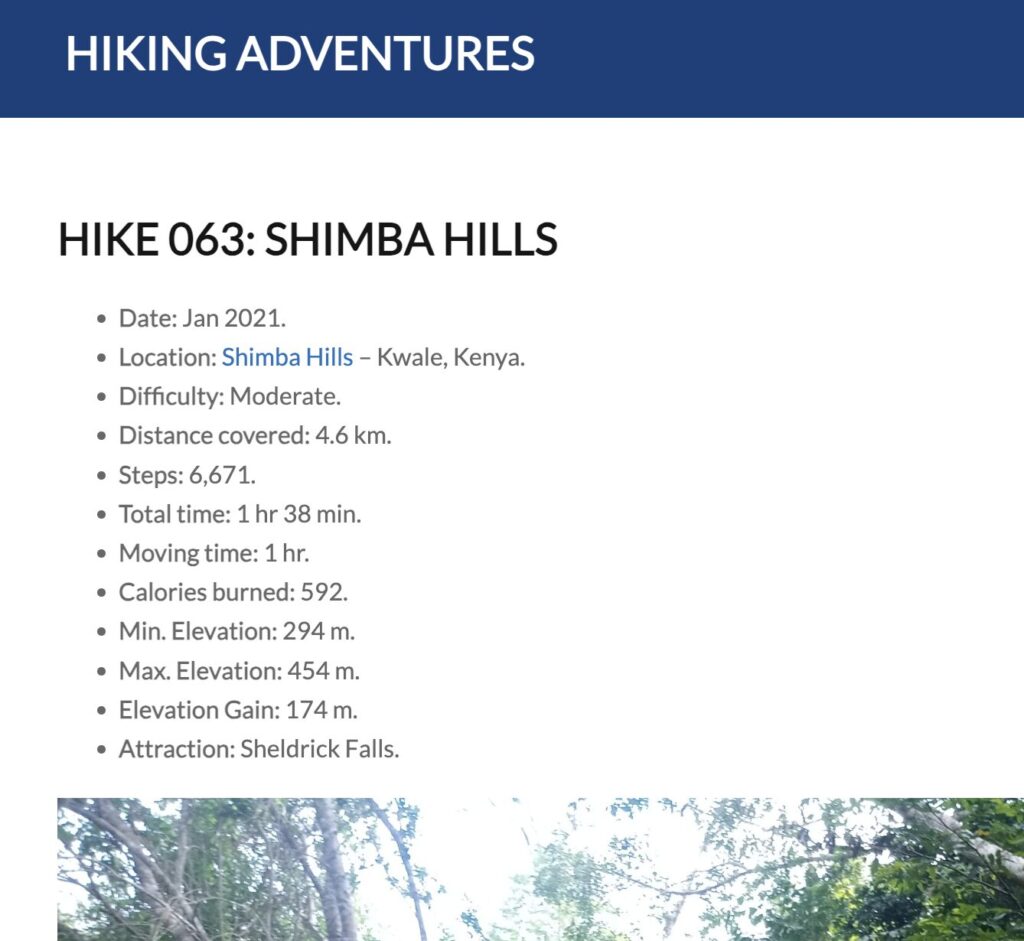
Independent hiking data from Hiking Adventures records a Shimba Hills hike to Sheldrick Falls as 4.6 km, moderate difficulty, 174 m elevation gain, and 1 hour 38 minutes total time for that logged outing. Actual visitor time can be longer if the group stops for photos, swims, rests, walks slowly, or visits during hot or slippery conditions.
Sheldrick Falls trail reality
| Trail Factor | What Visitors Should Expect |
|---|---|
| Distance | Commonly described around 4.6 to 5 km round trip |
| Effort | Moderate for active walkers |
| Hardest part | Return climb from the falls |
| Terrain | Uneven, rocky or slippery in places |
| Weather effect | Rain can make the trail harder; heat makes the climb tiring |
| Best footwear | Closed walking shoes with grip |
| Best group type | Active adults, older children, fit seniors |
| Less suitable for | Strollers, wheelchairs, toddlers, weak knees, rushed groups |
Expert local tip
Do not judge the walk by distance only. A 5 km walk on flat Diani beach sand is not the same as a humid forest descent and climb inside Shimba Hills. The return from Sheldrick Falls is where most visitors realize they should have carried more water.
Best Time of Day to Visit Sheldrick Falls
The best time to visit Sheldrick Falls is in the morning, before the day becomes too hot. A late waterfall start can make the climb back uncomfortable and can compress the rest of your Shimba Hills itinerary.
Timing guide
| Time | Best Use |
|---|---|
| Early morning | Game drive, birding, wildlife movement |
| Late morning | Best practical window for Sheldrick Falls |
| Midday | Hotter; use for lunch, rest, or low-effort stops |
| Afternoon | Better for viewpoints and relaxed exit drive |
| After rain | Waterfall may be more scenic, but trail can be slippery |
| Dry weather | Easier walking, but water flow may be less dramatic |
A good itinerary places Sheldrick Falls after a short morning wildlife drive but before the group becomes tired.
What to Wear for Sheldrick Falls and Shimba Hills Hiking
Wear clothes that match a warm, humid forest reserve, not a beach restaurant or hotel pool area.
Best clothing
- Lightweight breathable shirt
- Comfortable walking shorts or trousers
- Closed walking shoes or light hiking shoes
- Hat or cap
- Sunglasses
- Light rain jacket during wet periods
- Swimwear under clothes if your guide says water conditions are safe
- Neutral colors for wildlife viewing
Avoid
- Flip-flops
- Smooth-soled sandals
- Heavy jeans
- White shoes you care about
- Carrying heavy handbags
- Barefoot walking near the falls
- Dressing only for the beach
Nomad Africa’s Sheldrick Falls trek account also emphasizes practical preparation for the roughly five-kilometre round trip, including lightweight clothing, water, snacks, sunscreen, and swimwear if visitors plan to enjoy the pool.
What to Carry for Sheldrick Falls and Scenic Attractions
| Item | Why It Matters |
|---|---|
| Drinking water | Essential for the waterfall descent and climb back |
| Small backpack | Keeps your hands free on the trail |
| Binoculars | Useful for birds, monkeys, and distant wildlife |
| Camera or phone | Waterfall, forest, viewpoint, and wildlife photos |
| Hat | Reduces heat exposure |
| Sunscreen | Needed even when parts of the walk feel shaded |
| Insect repellent | Useful near forest and damp areas |
| Snacks | Helpful for children and slow walkers |
| Waterproof pouch | Protects phone and documents near the falls |
| Light towel | Useful if entering the pool area |
| ID or passport | Needed for entry category proof |
| Power bank | Helpful for photos and digital payment issues |
Expert local tip
Keep one bottle of water unused until the return climb. Many visitors drink most of their water during the game drive or descent, then struggle on the climb back. Mentally reserve trail water for the return, not only the walk down.
Can Children Visit Sheldrick Falls?
Older children can enjoy Sheldrick Falls if they can walk steadily, follow instructions, handle the climb back, and stay close to adults. It is less suitable for toddlers, children who tire quickly, or children who run ahead on trails.
Family planning tips
- Choose a private tour if possible.
- Start early.
- Carry snacks and extra water.
- Put children in closed shoes.
- Do not force the walk if it is too hot.
- Keep children between adults on narrow or uneven sections.
- Explain wildlife rules before leaving the vehicle.
- Be ready to skip the falls and use viewpoints instead.
For families, the best Shimba Hills day is flexible: game drive, monkeys, butterflies, picnic, viewpoint, and Sheldrick Falls only if the group is ready.
Is Sheldrick Falls Suitable for Seniors?
Sheldrick Falls can suit fit seniors, but it should not be treated as an easy universal activity. The return climb, humidity, uneven footing, and possible slippery ground need careful judgment.
Seniors should consider
| Factor | Why It Matters |
|---|---|
| Knee strength | The descent and climb can strain knees |
| Balance | Trail sections may be uneven |
| Heat tolerance | Humidity can make effort feel harder |
| Pace | Mixed groups often move too fast |
| Footwear | Grip matters after rain |
| Medical conditions | Heart, breathing, or mobility issues may make the walk unsuitable |
Better lower-strain alternatives
- Game drive
- Ocean View Point
- Pengo
- Birding from the vehicle
- Picnic stop
- Short scenic pauses
- Forest-edge photography
Wildlife Safety Around Sheldrick Falls and Hiking Areas
Shimba Hills is a wildlife reserve. Even scenic attractions sit inside a landscape used by elephants, buffalo, reptiles, monkeys, birds, and other wildlife.
Safety rules
- Do not walk without guide or ranger approval.
- Stay on the trail.
- Keep distance from elephants and buffalo.
- Do not feed monkeys.
- Do not touch snakes, frogs, lizards, insects, or nests.
- Watch where you step near damp rocks and leaf litter.
- Keep children close.
- Avoid loud shouting near wildlife areas.
- Do not enter water unless your guide says conditions are safe.
- Leave before your group becomes too tired for the return.
Shimba Hills is exciting because it is real habitat. Treat the walk as a controlled wildlife-area activity, not a casual picnic path.
Ocean View Point: Best Scenic View in Shimba Hills
Ocean View Point is one of the most important scenic attractions in Shimba Hills because it shows the reserve as a raised coastal landscape rather than only a forest safari area. On clear days, it gives visitors a broader sense of the hills, valleys, forest cover, and coastal direction.
Why visit Ocean View Point?
- It is easier than a long hike.
- It works well for families and seniors.
- It adds scenic value to a game drive.
- It helps photographers capture the landscape.
- It gives context to the reserve’s position above the coast.
- It is a useful stop if Sheldrick Falls is not suitable for the group.
Best time for Ocean View Point
| Time | Experience |
|---|---|
| Morning | Clearer air and softer light if weather is good |
| Midday | Bright light; useful if itinerary requires |
| Afternoon | Good scenic stop after lunch |
| Misty periods | Atmospheric but visibility may be reduced |
| After rain | Green landscapes but possible cloud cover |
Pengo: The Highest-Point Scenic Attraction
Pengo is commonly described as the highest point in Shimba Hills and is one of the reserve’s key scenic stops. It gives visitors a stronger sense of the hill system and why the reserve feels cooler, greener, and more elevated than the nearby coast.
Why Pengo matters
- It shows the reserve’s topography.
- It adds landscape variety to the itinerary.
- It works for visitors who cannot do Sheldrick Falls.
- It helps explain rainfall, forest cover, and water flow.
- It is useful for photography and conservation interpretation.
Parks.it lists several panoramic observation and picnic points in Shimba Hills, including Makadara Picnic Site, Giriama Point, Ocean View Point, Pengo Hill Lookout, and Elephant Hill, which helps expand the scenic-attractions cluster beyond Sheldrick Falls alone.
Shimba Hills Viewpoints and Photography Spots
Shimba Hills is good for photographers who want more than close-up animal portraits. Dense forest can make wildlife photography challenging, but the reserve rewards landscape, habitat, trail, waterfall, and environmental photography.
Best photography subjects
| Subject | Best Approach |
|---|---|
| Sheldrick Falls | Use wide shots, water detail, forest frame, and human scale |
| Ocean View Point | Capture layered hills and coastal direction |
| Pengo | Use the high-point perspective |
| Forest roads | Shoot depth, shade, and curve of the road |
| Elephants | Photograph in habitat, not only close-ups |
| Sable antelope | Use binoculars first; sightings are possible but not guaranteed |
| Birds | Carry a longer lens or binoculars |
| Butterflies | Look near damp patches and sunlit edges |
| Picnic scenes | Keep them low-impact and litter-free |
| Misty mornings | Excellent for forest atmosphere |
Photography advice
- Start early for softer light.
- Carry a lens cloth because humidity and spray affect cameras.
- Keep electronics protected at the falls.
- Do not ask guides to disturb wildlife for a photo.
- Photograph habitat, not only animals.
- Use viewpoints as story images for the reserve’s coastal-hill identity.
Hiking and Trekking in Shimba Hills
Hiking in Shimba Hills is mainly about guided forest and waterfall walking, not long independent wilderness trekking. The best-known hike is the Sheldrick Falls trail, but visitors may also experience shorter nature walks and scenic stops depending on guide arrangements and conditions.
Best hiking experiences
- Sheldrick Falls trail
- Guided forest walk
- Waterfall descent and climb
- Birding-oriented nature walk
- Butterfly and plant-focused slow walk
- Short viewpoint walks
- Picnic-and-walk combinations
Hiking checklist
| Planning Question | Best Answer |
|---|---|
| Is hiking allowed everywhere? | No, use approved routes and guide or ranger advice |
| Is the waterfall trail easy? | Moderate, mainly because of climb and humidity |
| Can you hike alone? | Not recommended inside wildlife habitat |
| Are shoes necessary? | Yes, closed shoes with grip |
| Is rain a problem? | It can make trails slippery |
| Is hiking good with kids? | Yes for older children, not toddlers |
| Is hiking good for seniors? | Only if fit and comfortable with uneven ground |
Nature Walks: Birds, Butterflies, Plants and Forest Detail
A Shimba Hills nature walk should not be judged only by whether it reaches a waterfall. The reserve has strong smaller biodiversity: birds, butterflies, amphibians, reptiles, rare plants, insects, and forest-edge life.
The Key Biodiversity Areas profile records Shimba Hills as a confirmed KBA with forest, grassland and shrubland habitats, threatened and restricted-range birds, endemic frogs, diverse butterflies, and about 1,100 plant taxa, which makes slow nature observation one of the most meaningful ways to experience the reserve.
What to notice on a nature walk
- Bird calls before sightings
- Butterflies near wet soil and flowers
- Monkey movement in trees
- Elephant signs such as dung or broken vegetation
- Rock and soil changes near the waterfall
- Leaf litter and amphibian habitat
- Forest layers and canopy openings
- Plant textures, vines, ferns, and flowering shrubs
A nature walk is best when the guide interprets the landscape rather than simply moving the group from point A to point B.
Birdwatching as a Scenic Attraction
Birdwatching is one of the best low-impact attractions in Shimba Hills. Even visitors who are not serious birders can enjoy the forest soundscape, hornbills, turacos, sunbirds, raptors, and grassland birds.
Best birding spots and methods
| Place or Habitat | What to Do |
|---|---|
| Forest roads | Stop and listen before scanning |
| Forest edge | Look for mixed flocks and canopy movement |
| Grassland openings | Watch for open-country species |
| Viewpoints | Scan for raptors |
| Sheldrick Falls trail | Listen for forest birds and watch damp-edge activity |
| Picnic areas | Watch carefully but do not feed wildlife |
SafariBookings highlights Shimba Hills as a birding destination with forest and grassland species and notes species such as Fischer’s turaco, green-headed oriole, East Coast akalat, Uluguru violet-backed sunbird, hornbills, southern banded snake-eagle, spotted ground-thrush, and Sokoke pipit.
Butterfly Watching and Small Wildlife Attractions
Butterfly watching is an underrated Shimba Hills attraction. Visitors often focus on elephants, sable antelope, and Sheldrick Falls, but the reserve’s smaller life is one of its strongest ecological stories.
Where to look for butterflies
- Sunlit forest edges
- Damp ground near the falls
- Flowering plants
- Quiet road edges
- Streamside vegetation
- Open glades after rain
- Picnic areas with nearby vegetation
UNESCO’s Coastal Forests of Kenya tentative listing highlights Shimba Hills’ rich flora and fauna, Kenya’s only sable antelope population, elephants, endemic frogs, diverse butterflies, and strong plant diversity, making the reserve’s smaller biodiversity central to its attraction value.
Camping and Picnicking in Shimba Hills
Camping and picnicking are part of the Shimba Hills visitor experience, but they should be planned responsibly. The reserve is wild enough that food, waste, monkeys, insects, and timing all matter.
Picnic advice
- Carry enough water.
- Pack food that travels well in warm weather.
- Keep food sealed.
- Do not feed monkeys, birds, or any wildlife.
- Carry out all waste.
- Use appropriate picnic areas.
- Avoid leaving food scraps near trails or viewpoints.
- Plan lunch after the waterfall walk if the group needs recovery time.
Camping advice
- Confirm current campsite access and fees.
- Bring proper camping gear.
- Ask about water, toilets, and security.
- Do not assume food is available.
- Plan night movement carefully.
- Respect quiet hours and wildlife presence.
KWS Reservations notes Shimba Hills as having scenic Sheldrick Falls, Mwaluganje Forest, and four campsites, which supports camping and overnight nature-stay searches around the reserve.
How to Combine Sheldrick Falls With a Game Drive
The best Shimba Hills day combines attractions in a sensible order. Do not leave the waterfall until the group is hot, hungry, and tired.
Best full-day activity order
| Stage | Activity | Why It Works |
|---|---|---|
| 1 | Early pickup from Diani, Ukunda, Tiwi, Kwale, or Mombasa | Protects the best morning hours |
| 2 | Enter reserve and start game drive | Cooler conditions improve wildlife viewing |
| 3 | Search forest edges and grassland openings | Best for sable antelope habitat, elephants, birds |
| 4 | Walk to Sheldrick Falls | Better before strong midday heat |
| 5 | Rest, hydrate, lunch or picnic | Helps recovery after the trail |
| 6 | Ocean View Point or Pengo | Adds scenic context without too much strain |
| 7 | Slow exit drive | Gives final birding, photography, and wildlife chances |
Half-day version
If time is limited, choose:
- Game drive
- One viewpoint
- Short birding or photography stop
Do not force Sheldrick Falls into a rushed half-day unless the group is fit, close to the reserve, and already prepared.
Best Attractions for Different Visitors
| Visitor Type | Best Attractions |
|---|---|
| First-time visitor | Game drive, Sheldrick Falls, Ocean View Point |
| Active traveler | Sheldrick Falls hike, forest walk, viewpoint stops |
| Family with kids | Game drive, monkeys, butterflies, picnic, viewpoint, optional falls |
| Senior traveler | Vehicle-based game drive, Ocean View Point, Pengo, picnic |
| Photographer | Sheldrick Falls, viewpoints, forest roads, birds, butterflies |
| Birder | Forest edges, Sheldrick Falls trail, viewpoints, grasslands |
| Couple | Private game drive, waterfall, scenic viewpoint |
| Budget traveler | Game drive, picnic, one main scenic attraction |
| Conservation-minded visitor | Sable habitat, elephant signs, birds, butterflies, forest interpretation |
| Repeat visitor | Slower nature walk, birding, picnic, viewpoint photography |
Shimba Hills Attractions Compared
| Attraction | Effort Level | Best Reason to Include It | Skip If |
|---|---|---|---|
| Sheldrick Falls | Moderate | Main waterfall and active forest experience | Group is tired, unfit, or trail is slippery |
| Game drive | Low to moderate | Core safari and wildlife activity | Never skip on first visit |
| Ocean View Point | Low | Scenic landscape and photography | Visibility is poor or time is too tight |
| Pengo | Low to moderate | Highest-point landscape context | Route is already overloaded |
| Nature walk | Moderate | Birds, butterflies, plants, forest detail | No guide, too hot, or too rushed |
| Picnic | Low | Comfort and pacing | Food not planned or monkeys are too close |
| Camping | High planning | Overnight nature experience | You lack gear or confirmed campsite details |
| Birdwatching | Low | Adds value even when mammals are hidden | Group is impatient |
Common Mistakes When Visiting Shimba Hills Attractions
| Mistake | Better Approach |
|---|---|
| Treating Sheldrick Falls as a casual short walk | Plan it as a moderate guided trail |
| Wearing flip-flops | Wear closed shoes with grip |
| Starting too late | Leave early and protect the morning |
| Trying to do every attraction in a half-day | Choose game drive plus one scenic stop |
| Ignoring viewpoint weather | Visit viewpoints when visibility is good |
| Forgetting water | Carry water for both drive and trail |
| Feeding monkeys during picnic | Keep food sealed and never feed wildlife |
| Expecting open-savannah wildlife | Watch forest edges, grasslands, and signs |
| Not using guide support | Use local knowledge for route, safety, and interpretation |
| Skipping smaller biodiversity | Notice birds, butterflies, plants, and insects |
Recommended Page Cluster for ShimbaHillsReserve.org
| Page Title | Suggested URL | Main Purpose |
|---|---|---|
| Sheldrick Falls Shimba Hills Guide | /sheldrick-falls-shimba-hills/ | Main waterfall page |
| Things to Do in Shimba Hills | /things-to-do-in-shimba-hills/ | Main activity guide |
| Sheldrick Falls Hike and Trail Guide | /sheldrick-falls-hike/ | Trail difficulty, shoes, timing, safety |
| Shimba Hills Viewpoints Guide | /shimba-hills-viewpoints/ | Ocean View Point, Pengo, scenic views |
| Shimba Hills Nature Walk Guide | /shimba-hills-nature-walk/ | Guided walks, forest trails, ecology |
| Shimba Hills Photography Guide | /shimba-hills-photography-spots/ | Waterfall, wildlife, sunrise, viewpoints |
| Shimba Hills Picnic Guide | /shimba-hills-picnic-sites/ | Family and local visitor planning |
| Shimba Hills Hiking Guide | /shimba-hills-hiking/ | Broader hiking and trekking guide |
Suggested Image Placement Inside the Article
Use images strategically rather than placing them randomly.
| Section | Best Image Type | Suggested Caption |
|---|---|---|
| Opening section | Wide Shimba Hills landscape | Shimba Hills National Reserve combines forest, hills, wildlife, waterfalls, and viewpoints |
| Sheldrick Falls section | Waterfall photo | Sheldrick Falls is the main waterfall attraction inside Shimba Hills |
| Hiking section | Trail or walking image | The Sheldrick Falls walk needs proper shoes, water, and guide support |
| Viewpoints section | Hill or valley panorama | Ocean View Point and Pengo reveal the coastal-hill landscape |
| Nature walks section | Forest, birds, butterflies, plants | Shimba Hills rewards slow observation beyond large mammals |
| Picnic section | Scenic rest area | Picnic responsibly and carry all waste out of the reserve |
Frequently Asked Questions About Shimba Hills Attractions
What is the main attraction in Shimba Hills?
Sheldrick Falls is the best-known scenic attraction, while the wider reserve experience also includes game drives, sable antelope habitat, elephants, Ocean View Point, Pengo, hiking, birding, picnicking, and camping.
Is Sheldrick Falls inside Shimba Hills National Reserve?
Yes. Sheldrick Falls is inside Shimba Hills National Reserve and is normally visited as part of a reserve trip with game drive and guided walking arrangements.
How hard is the Sheldrick Falls hike?
The Sheldrick Falls hike is moderate for active visitors. The return climb, humidity, heat, and slippery ground after rain can make it more tiring than expected.
Do you need a guide for Sheldrick Falls?
Visitors should plan to use a guide or ranger because the trail is inside wildlife habitat and the route is safer with local support.
Can children visit Sheldrick Falls?
Older children can visit if they can manage the walk and follow instructions. Very young children may struggle, especially in heat or after rain.
Is Sheldrick Falls suitable for seniors?
It depends on fitness, balance, knees, heat tolerance, and trail condition. Seniors who prefer a low-strain visit can focus on game drives, Ocean View Point, Pengo, birding, and picnic stops.
What should I wear to Sheldrick Falls?
Wear breathable clothing and closed walking shoes with grip. Avoid flip-flops, smooth sandals, and heavy clothing.
What should I carry for Shimba Hills attractions?
Carry water, ID, phone, camera, binoculars, sunscreen, hat, sunglasses, snacks, insect repellent, rain layer, and a small daypack for the waterfall trail.
Can you swim at Sheldrick Falls?
Some visitors enter the pool when conditions are safe, but you should always ask your guide first. Do not enter during unsafe water flow, poor footing, or unclear conditions.
What are the best scenic viewpoints in Shimba Hills?
Ocean View Point and Pengo are the main scenic viewpoint names associated with the reserve. Other picnic and observation points may be included depending on route and guide advice.
Is Shimba Hills good for hiking?
Yes, especially for Sheldrick Falls and guided nature walks. It is not a free-roaming hiking park; use approved routes and guide or ranger support.
Is Shimba Hills good for photography?
Yes. The best subjects are Sheldrick Falls, forest roads, viewpoints, elephants in habitat, monkeys, birds, butterflies, misty mornings, and landscape layers.
Can you picnic in Shimba Hills?
Yes, picnicking is listed among reserve experiences. Visitors should carry food responsibly, avoid feeding wildlife, and take all litter out.
Final Visitor Advice
The best way to experience Shimba Hills attractions is to combine a slow game drive, Sheldrick Falls, one viewpoint, and enough time for birds, butterflies, forest scenery, and a picnic or lunch break. Do not treat the reserve as a quick waterfall stop or a mini version of Tsavo. Its real appeal is the mixture of coastal forest, walking trails, hill scenery, wildlife, water, and quiet biodiversity.
For most visitors, the ideal plan is simple: start early, enter smoothly, do a morning game drive, walk to Sheldrick Falls before the day becomes too hot, rest and hydrate, then visit Ocean View Point or Pengo before returning to the coast. This gives the reserve enough time to feel like a landscape, not just a list of attractions.